Washington, Dec 16
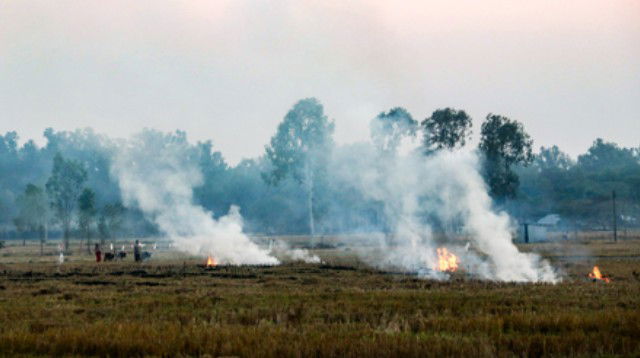
Seasonal crop fires across northern India are increasingly being lit later in the day, a shift that scientists say could complicate efforts to monitor stubble burning and assess its impact on air quality, according to satellite observations and recent studies, NASA has said.
For decades, long rivers of smoke and haze have spread across the Indo-Gangetic Plain from October to December as farmers burn off crop residue after the rice harvest. In 2025, the overall pattern of the stubble-burning season largely followed expectations, but the daily timing of fires showed a notable departure from past trends, a NASA release said Monday.
In some ways, the seasonal timing of stubble fires in 2025 followed typical patterns, said Hiren Jethva, a Morgan State University atmospheric scientist based at NASA’s Goddard Space Flight Center. He noted that air quality deteriorated in Delhi and several other cities for about a month after crop fires intensified during the last week of October.
For about a decade, Jethva has tracked stubble burning in India using satellite data and has predicted the intensity of upcoming fire seasons based on vegetation observations. In earlier years, most fires were typically set in the early afternoon, between 1 p.m. and 2 p.m. local time.
However, that pattern has changed. “But in the past few years, stubble fires have occurred progressively later in the day,” Jethva said. His analysis shows that most stubble fires now happen between 4 p.m. and 6 p.m. “Farmers have changed their behavior,” he said.
Jethva identified the shift by analyzing data from GEO-KOMPSAT-2A, a South Korean geostationary satellite launched in late 2018 that collects observations every 10 minutes. By contrast, fire-monitoring systems that rely primarily on sensors such as MODIS or VIIRS, which pass over locations only once or twice a day, can miss many of these later-burning fires.
Satellite imagery illustrates the scale of the problem, scientists said. On November 11, 2025, the MODIS instrument on NASA’s Aqua satellite captured a thick plume of smoke and haze spreading across Punjab, Haryana, Uttar Pradesh, and Madhya Pradesh.
According to news reports, it was the first of several days in 2025 when pollution levels exceeded 400 on India’s air quality index, the strongest rating on the scale.
As in previous years, the spike in pollution prompted authorities in some areas to close schools and impose stricter controls on construction activity. When winds are weak and atmospheric conditions are stagnant, the resulting haze can push pollution levels several times above World Health Organization limits.
Jethva’s analysis indicates that stubble-burning activity in Punjab and Haryana in 2025 was moderate compared to other recent years. He found that fire counts were higher than in 2024, 2020, and 2019, but lower than in 2023, 2022, and 2021.
Indian researchers have independently identified a similar shift in timing. In a Current Science study published in 2025, scientists reported that Meteosat Second Generation satellite observations showed peak fire activity moving from about 1:30 p.m. in 2020 to about 5:00 p.m. in 2024. In December 2025, researchers at the International Forum for Environment, Sustainability, & Technology released a multi-satellite analysis that reached a similar conclusion.
While the link between stubble burning and Delhi’s air pollution is widely acknowledged, scientists continue to debate the precise contribution of crop fires relative to other sources such as vehicles, industry, domestic cooking and heating, fireworks, and dust storms. “Studies report contributions ranging from 10 to 50 per cent,” said Pawan Gupta, a NASA research scientist specializing in air quality.
Gupta estimates that stubble burning accounts for 40 to 70 per cent of pollution on a given day during peak episodes, dropping to 20 to 30 per cent when averaged over a month, and to under 10 per cent when averaged annually. “Meteorological conditions—like a shallow boundary layer height and low temperature—during the burning season add extra complexity,” he said.
Scientists say the later timing of fires could influence how pollution builds up overnight, as evening burns may coincide with weaker winds and a shallower boundary layer, allowing pollutants to accumulate more efficiently.